
Goshen Previous-Resident Sources
The best source depends on the date and the fact sought. A deed proves a recorded transfer. A directory or census can place previous residents at an address. A Sanborn sheet shows the building and its use, not its residents. Goshen's surviving runs overlap enough to build a careful timeline when every entry is labeled by source and year.
| Source | Years It Covers | Where Held | What It Shows |
|---|---|---|---|
| Recorded deeds | Permanent record; online cutoff not published | Elkhart County Recorder and Tapestry | Grantor, grantee, instrument, and legal description |
| Goshen directories | Selected years, 1883-1997 | Goshen Public Library Indiana Room | Dated name, address, and work clue |
| Combined directories | 1998-current | Goshen Public Library | Elkhart and Goshen address context |
| Federal census | Local microfilm, 1830-1920 | Library reader and databases | Household, age, work, and family links |
| Sanborn maps | 1886-1926 and 1926-1945 | Library, State Library, and online | Building form, use, number, and street setting |
| Newspapers | 1837-2022 on microfilm | Goshen Public Library | Obituary, sale, wedding, and address leads |
For a recent chain, start with Beacon and the latest deed. For an early twentieth-century household, pair a directory with the closest census and Sanborn edition. For a death or departure, use the newspaper indexes, funeral-home collections, cemetery books, and probate files as endpoints.
Start With a Goshen Parcel
Search the current address through the Elkhart County Assessor Beacon route. Save the parcel number, situs address, owner name, mailing address, transfer data, and Property Record Card. The card can also show the township, neighborhood, lot size, values, effective year built, and building features.
Do not treat the effective year built as an exact construction date. Remodels can change it. Likewise, a mailing address is not proof of where the owner lives. The parcel number and legal description are the durable keys for the backward trail because street labels can vary over time.
Trace Goshen Owners Through Deeds
The Elkhart County Recorder keeps deeds and other land instruments as permanent public records. Tapestry supplies the online path, but no official source states the first online year. A search that stops online has not reached the end of the county's record.
- Find the present owner and legal description on the parcel card.
- Locate that owner's purchase deed and copy its instrument number, date, grantor, grantee, and description.
- Search the seller as a grantee to locate the seller's earlier purchase.
- Repeat the grantor-to-grantee link while checking that the legal description still matches.
- When Tapestry stops, use the Recorder's public computer or send a precise copy request with names, dates, book and page, or instrument number.
- Grantor
- The party conveying the recorded interest.
- Grantee
- The party receiving that interest.
- Chain of title
- The linked sequence of recorded transfers for one property.
- Legal description
- The land description that can remain stable even when a street number changes.
The Recorder does not perform an open-ended title search and cannot give legal advice. Certified copies come from the office, not from a screenshot.
Open the Tapestry deed search before viewing its captured landing screen.
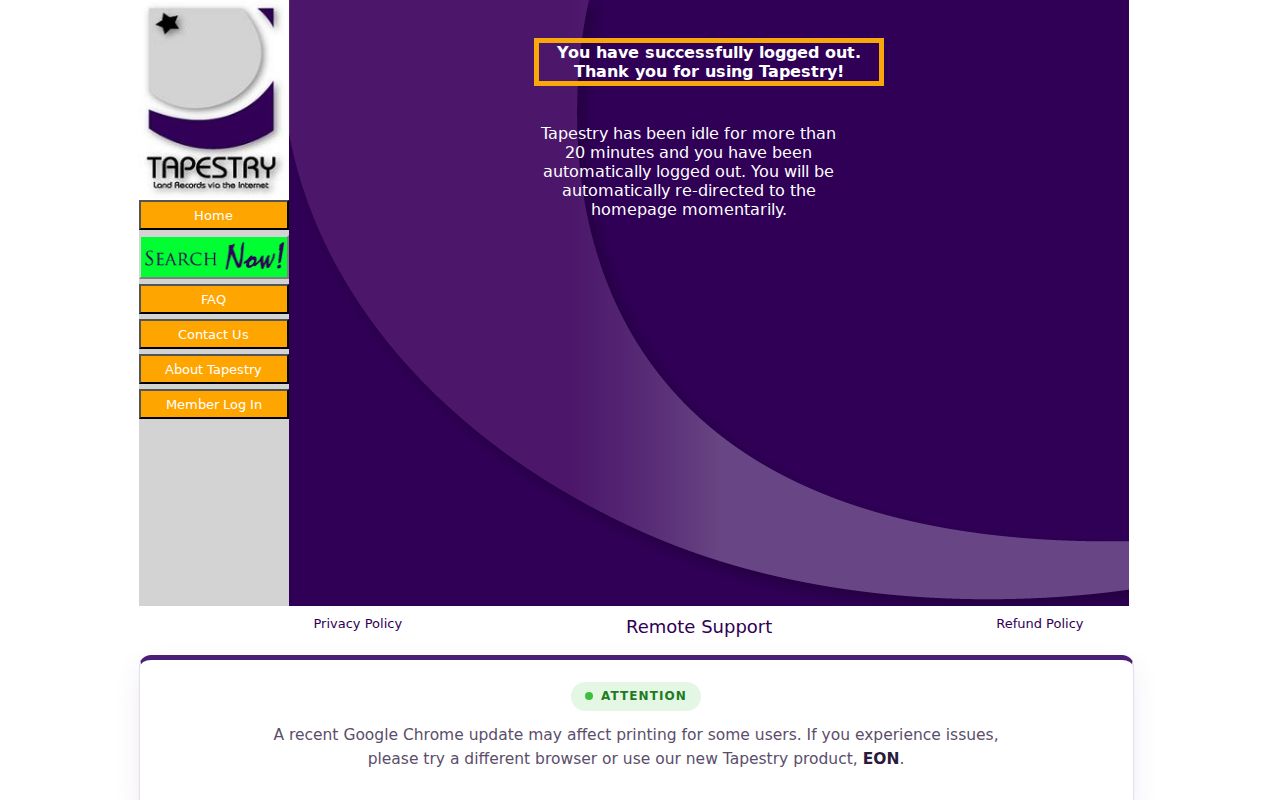
The captured page documents the portal route, while the office computer remains the key fallback for an incomplete session or older index.
Goshen Directories Bridge Deed Gaps
The Goshen Public Library lists local directory volumes for 1883, 1890, 1897, 1908-09, 1912, 1921, many later single years, continuous runs for 1964-1980 and 1982-1997, then combined Elkhart and Goshen directories from 1998 through the current year. The gaps matter. A missing volume is not proof that previous residents left.
Once a deed supplies an owner and time span, check the nearest directory before and after the transfer. Copy the printed address exactly and expand its abbreviations. A name may include an occupation, employer, partnership, spouse clue, or directional residence. Those details help distinguish two people with the same name.
The Goshen city directory collections deserve their own shelf-by-shelf treatment. For house history, use each volume only as a dated occupancy clue.
Map Past Goshen Addresses
Sanborn fire-insurance maps give Goshen editions for 1886, 1892, 1896, 1901, 1905, 1910, 1917, 1926, and a 1926-1945 run. A sheet may show street names, house or block numbers, building footprint, use, materials, doors, windows, and street width. It does not name residents.
Use the map between a deed and directory. If the directory gives a corner or compass-side description, the sheet can place that description on a block. If a building's use or footprint changes, the map helps explain why the same lot produces different address clues.
Consult the Indiana State Library's Goshen Sanborn list before viewing the captured edition page.
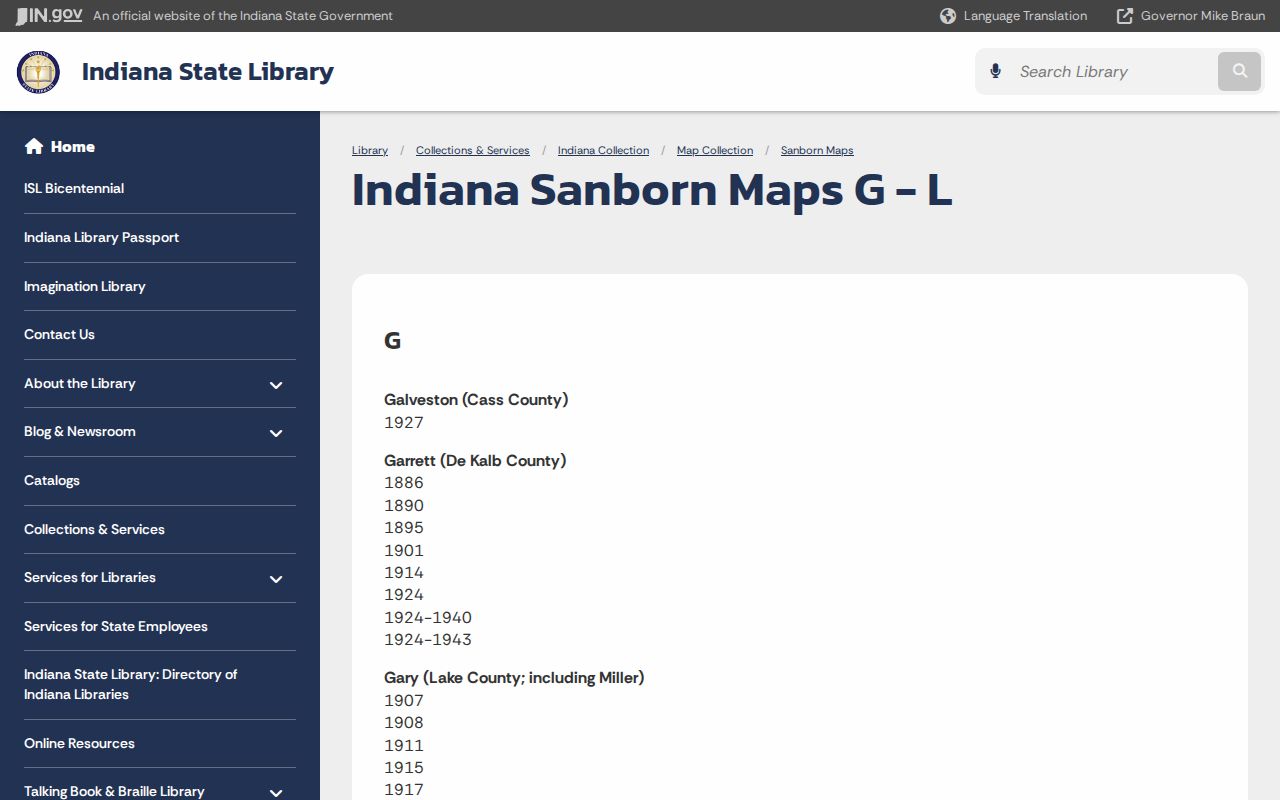
The edition list lets a researcher select the nearest map date instead of forcing a present-day address onto an older block.
Handle Changed Goshen Address Clues
No official Goshen citywide renumbering year was located. That gap should remain visible. An 1885-86 entry may say a compass side, a corner, or a distance from a road instead of giving a modern house number. Do not assume the old number equals today's situs address.
Translate the clue with a plat, legal description, cross street, Sanborn sheet, and nearby directory entries. The historic district, Millrace, rail corridors, and long-lived street junctions can provide geographic anchors. A USPS label is not proof that a parcel sat inside the city limit at the earlier date.
Address tip. Record the old wording exactly before trying variants; abbreviations such as cor, nr, and directional letters can change the result.
Pair Goshen Directories and Census
Owners are only one part of the story. A directory can place previous residents at an address, while a census schedule may reveal a household, ages, kin links, and work. Pairing them narrows the chance that a same-name person has been attached to the wrong house.
- Choose the directory year closest to the known deed, move, birth, or death.
- Copy the full entry, address wording, work detail, and abbreviation expansions.
- Open the nearest available federal census through the library's microfilm or databases.
- Compare names, ages, relationships, work, nearby households, and street sequence.
- Check a newspaper, obituary, marriage, cemetery, or probate lead before treating the match as one identity.
Goshen Library's census microfilm covers 1830-1920, and its historic newspapers span 1837-2022. HeritageQuest is available remotely to library cardholders; in-library Ancestry access and the microfilm reader provide other routes.
Find Goshen Household Endpoints
Obituaries and burial sources help explain when past residents died, moved, married, or joined another household. Goshen Library holds an obituary card file for 1970-1994, index support for 1994-2007, and a Goshen News Index from 2007 forward. These are separate eras, not one seamless database.
The Indiana Room also holds funeral-home indexes and cemetery books for Oakridge, Prairie Street, Rice, Violett, and West Goshen. Probate and will records belong with the Elkhart County Clerk. A cemetery entry can identify a burial and supply dates or family clues, but it does not prove the person occupied a certain address without a directory, census, deed, or newspaper link.
Review the Oakridge Cemetery history and index notes before viewing the captured record page.
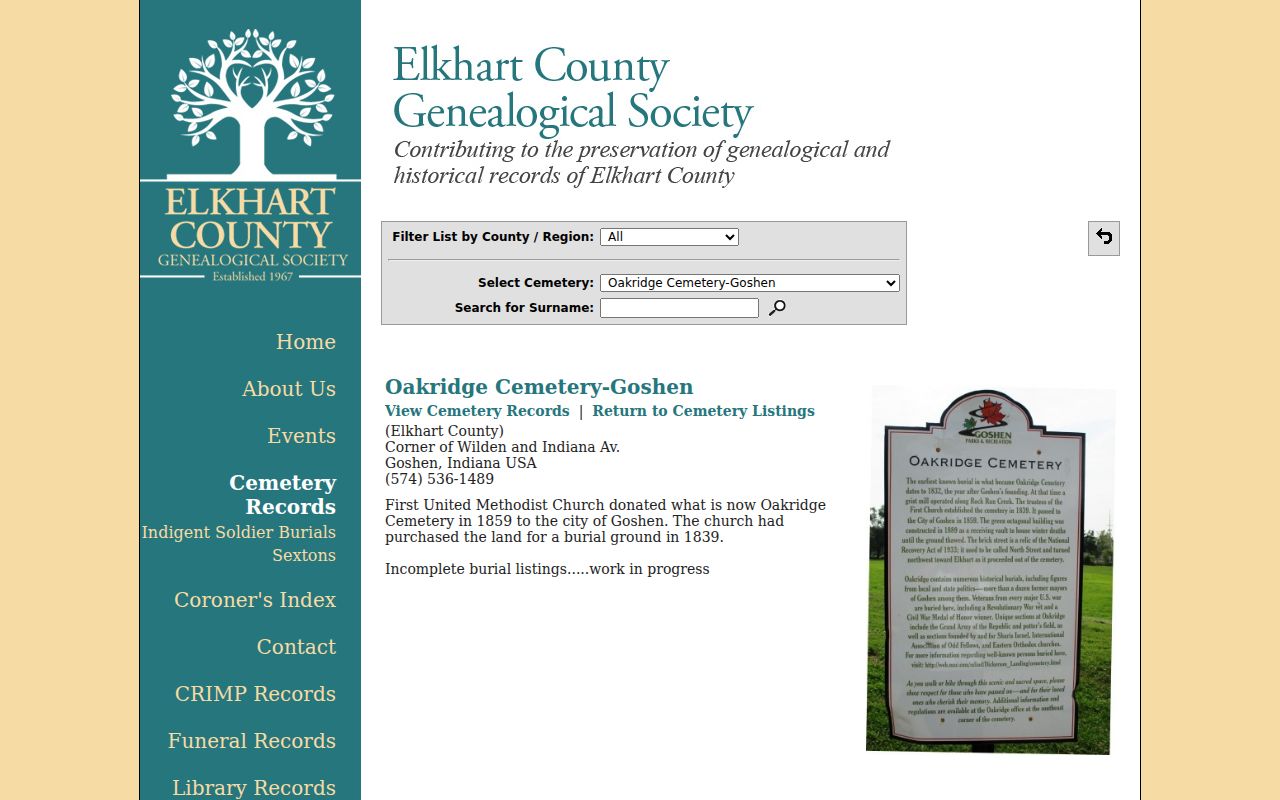
The cemetery record can close a life timeline, but it must be connected back to the address with dated evidence.
Three Goshen Cemetery Histories
Oakridge, Violett, and West Goshen are not interchangeable search labels. Each has its own origin and naming history. The West Goshen notes also warn that some stones may not stand in their original positions, so a marker's location should not be overread as a precise family plot history.
When a past household appears near a cemetery, search the cemetery by surname, then confirm the result with an obituary, funeral-home index, or death record. Goshen Library staff can help with local obituary questions by mail or email, which is useful when a name index provides only a date or title.
Log Goshen Previous-Resident Evidence
A useful log has one row per source, with the source title, custodian, date accessed, record date, exact address, names, parcel or instrument number, page or sheet, fact type, and next step. Mark each item as owner, occupant clue, event, structure, or map evidence.
Conflicts belong in the log. A parcel card and directory can both be accurate while naming different people because they answer different questions. A blank directory year may reflect a missing volume, and a Tapestry stop may reflect an unpublished online cutoff. Ask the Goshen Public Library, Recorder, Clerk, State Library, or Archives for the next documented channel rather than filling a gap with a guess.
The Indiana Archives historical vital-record route can extend a trail when a local index points to an older statewide holding.
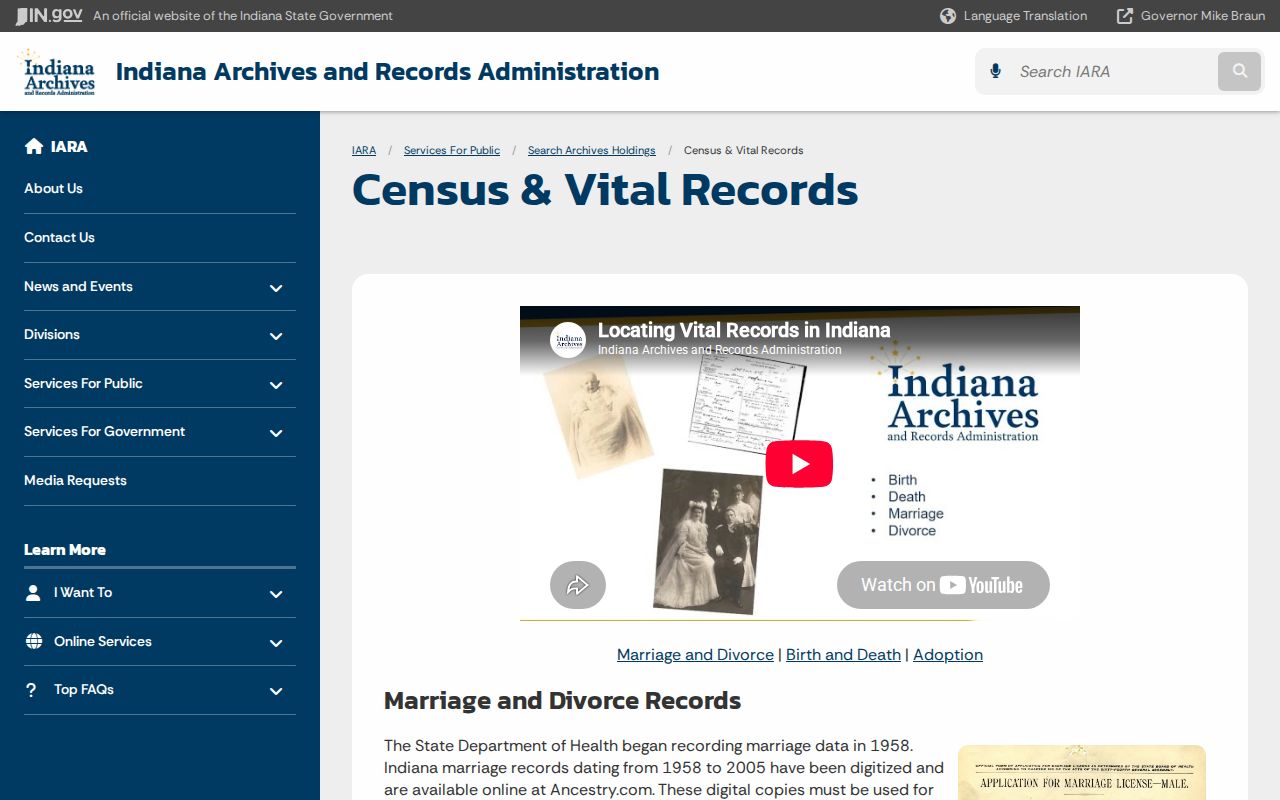
The archives route adds a documented fallback, while the original custodian remains the place to request an official copy.
Use Goshen House Records Lawfully
Previous-resident research is well suited to family history, heir questions, preservation work, and curiosity about a building. Old public records can still contain errors or sensitive facts. Verify names with the custodian, avoid publishing a living person's address, and stop if a source suggests an Address Confidentiality Program record.
Commercial search products may merge people and addresses without showing the source date. A Goshen house timeline is stronger when it cites the parcel card, recorded deed, directory volume, census page, map sheet, or newspaper item directly.
Lawful use. Never use previous-resident records to stalk, harass, monitor, threaten, or reveal a protected person.